Most seniors can begin with 1 set of 8–10 safe squats, two or three days each week.
Knowing how many squats should a senior do is important because the right amount depends on strength, balance, joint health, and exercise experience. A chair squat can build useful strength for standing, climbing stairs, and getting in and out of a car, but safe form matters more than a high number. This guide explains how to start, how to progress, and when to ask a health professional for help.
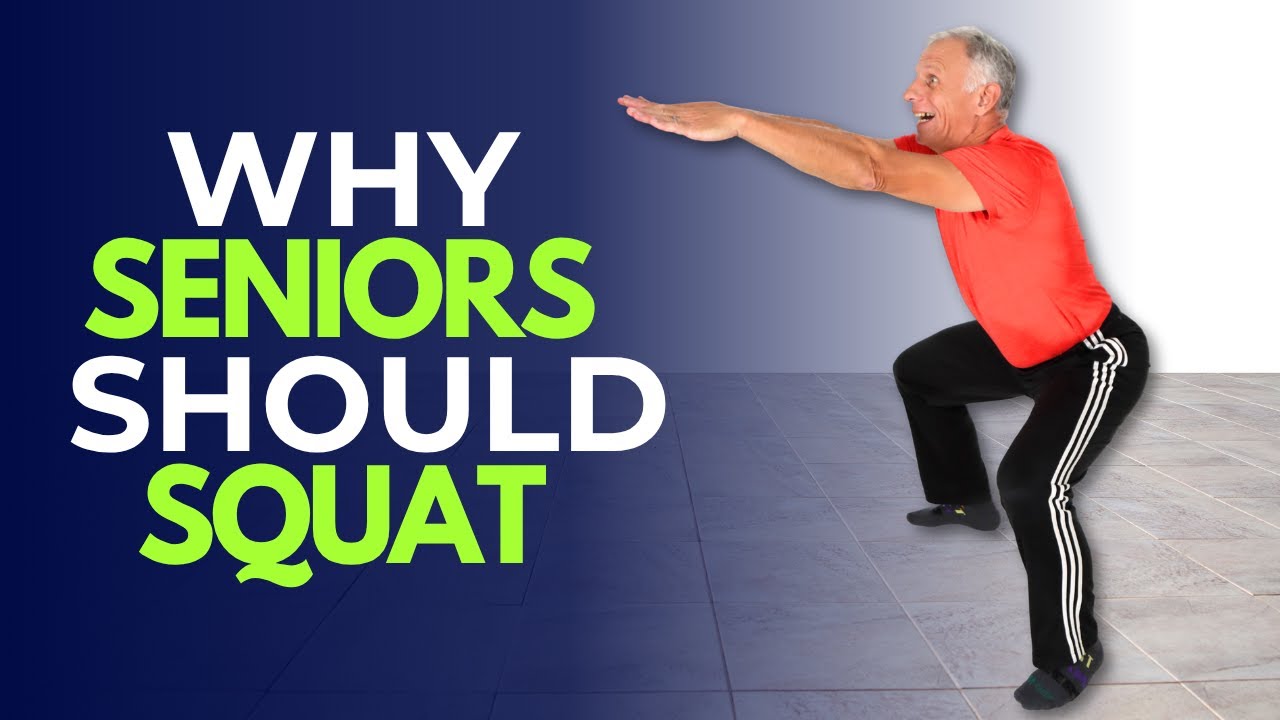
How Many Squats Should a Senior Do?
There is no single number that fits every older adult. For many healthy seniors, a good starting point is 1 set of 8 to 10 chair squats, performed 2 or 3 days per week.
If that feels easy and pain-free after several sessions, progress slowly to:
• 2 sets of 8 to 12 squats
• 2 or 3 exercise days each week
• About 60 to 90 seconds of rest between sets
• A steady pace with controlled movement
The answer to how many squats should a senior do may be lower for someone who is new to exercise, recovering from illness, or dealing with poor balance. In that case, 3 to 5 partial squats may be enough at first.
The goal is not to “push through” pain. The goal is to make daily movement feel easier and safer. Think of squats as practice for life, not a test of willpower.

A Safe Starting Plan for Older Adults
A simple plan can help you build strength without doing too much too soon. Use a strong chair that does not slide, and place it near a wall or counter for extra support.
Follow these steps:
-
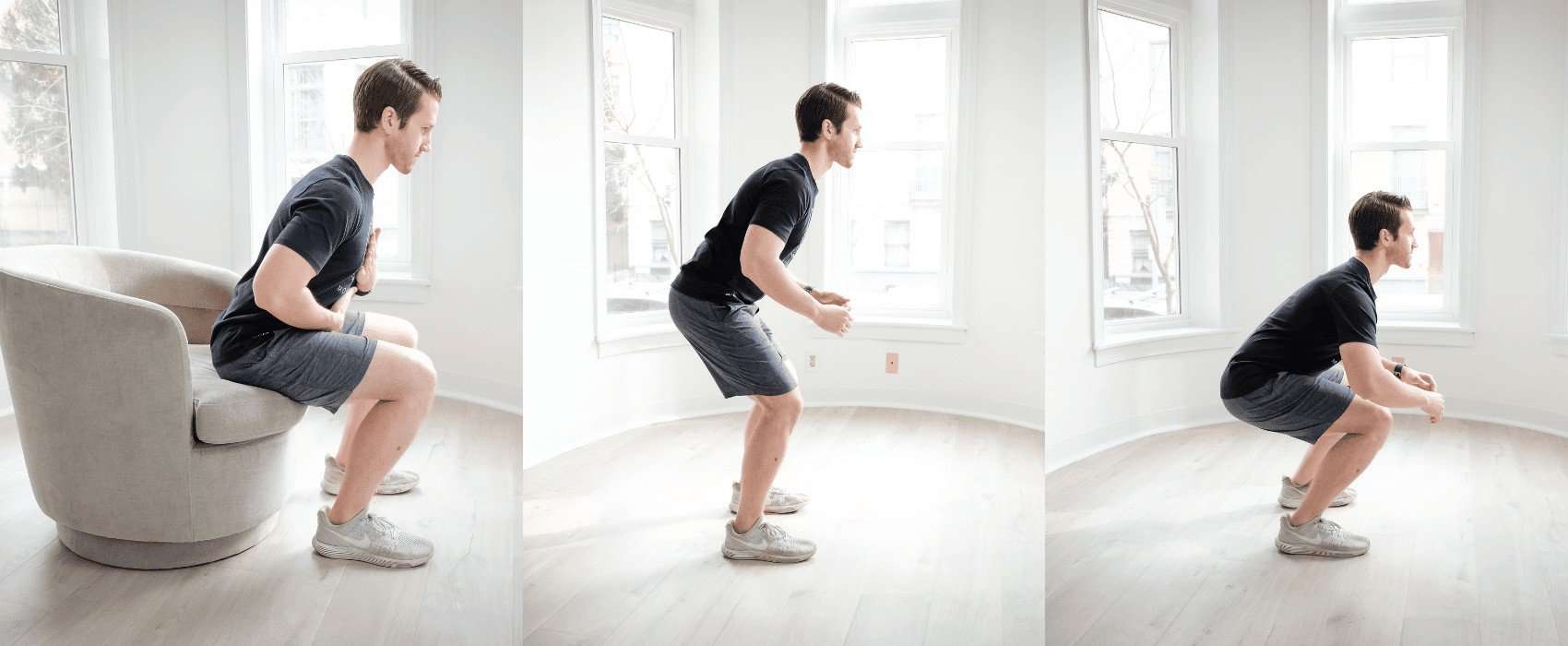
Stand in front of the chair with your feet about shoulder-width apart.
-
Keep your toes pointed forward or slightly outward.
-
Hold your arms forward or lightly touch a counter.
-
Bend your knees and push your hips back as if you are about to sit.
-
Lower only as far as you can while keeping control.
-
Pause briefly above the chair or lightly touch the seat.
-
Press through your feet to stand tall.
-
Breathe out as you stand.
If you cannot lower very far, that is fine. A small movement still trains the thighs, hips, and buttocks. As strength improves, you may lower a little more.
When people ask how many squats should a senior do, I usually suggest starting with a number that leaves two or three good repetitions “in reserve.” You should feel that you could do a little more, but you should not feel exhausted or shaky.
Why Squats Matter for Seniors
Squats train several muscles used in everyday activities. These include the quadriceps at the front of the thighs, the gluteal muscles in the hips, and the muscles that support the trunk.
Regular strength training may help older adults:
• Stand up from a chair with less effort
• Walk up steps more easily
• Improve lower-body strength
• Support balance and movement control
• Maintain independence
• Reduce muscle loss linked with inactivity and aging
• Improve confidence during daily tasks
Squats alone do not prevent every fall. Fall risk can involve vision, medication, footwear, balance, blood pressure, and home hazards. Still, stronger legs can make it easier to react, step, and recover when balance changes.
The best answer to how many squats should a senior do also considers the rest of the week. Older adults benefit from a mix of strength work, walking or other aerobic activity, balance exercises, and flexibility work.

How to Choose the Right Squat Variation
Not every senior should begin with a free-standing squat. The best version is the one that allows smooth, confident movement.
Chair squats
Chair squats are often the safest starting choice. The chair gives you a target and can provide support if your legs become tired.
Use a firm chair with a flat seat. Avoid chairs with wheels or very soft cushions.
Supported squats
Hold a kitchen counter, sturdy table, or grab bar while squatting. Keep your grip light when possible so your legs do most of the work.
This option may suit someone who has mild balance concerns but can still stand and walk safely.
Partial squats
Lower only a few inches. Partial squats can help someone build strength before trying a deeper movement.
They are also useful for people with limited knee or hip motion.
Sit-to-stand exercises
Sit fully in a chair, then stand without using your hands if you can do so safely. Sit down slowly.
This exercise closely matches daily life and may be easier to understand than a standard squat.
Wall squats
A wall squat can offer support, but it may place more demand on the knees. It is best used only when a person can control the movement well.
A physical therapist can help decide whether this variation is suitable.
How Many Squats Should a Senior Do at Different Fitness Levels?
Fitness level changes the right starting point. The following ranges are general examples, not strict rules.
Beginner
Start with 1 set of 5 to 8 chair squats, 2 days per week. Rest as needed, and focus on a slow descent and steady stand.
Moderately active senior
Try 1 or 2 sets of 8 to 12 chair or supported squats, 2 or 3 days per week. Add balance work and walking on other days.
Strong and experienced senior
You may complete 2 or 3 sets of 8 to 15 bodyweight squats, provided your form stays controlled and your joints feel well. A trainer or physical therapist can help you add resistance safely.
The question of how many squats should a senior do should always include exercise quality. Ten smooth squats are more useful than twenty rushed repetitions with poor balance.
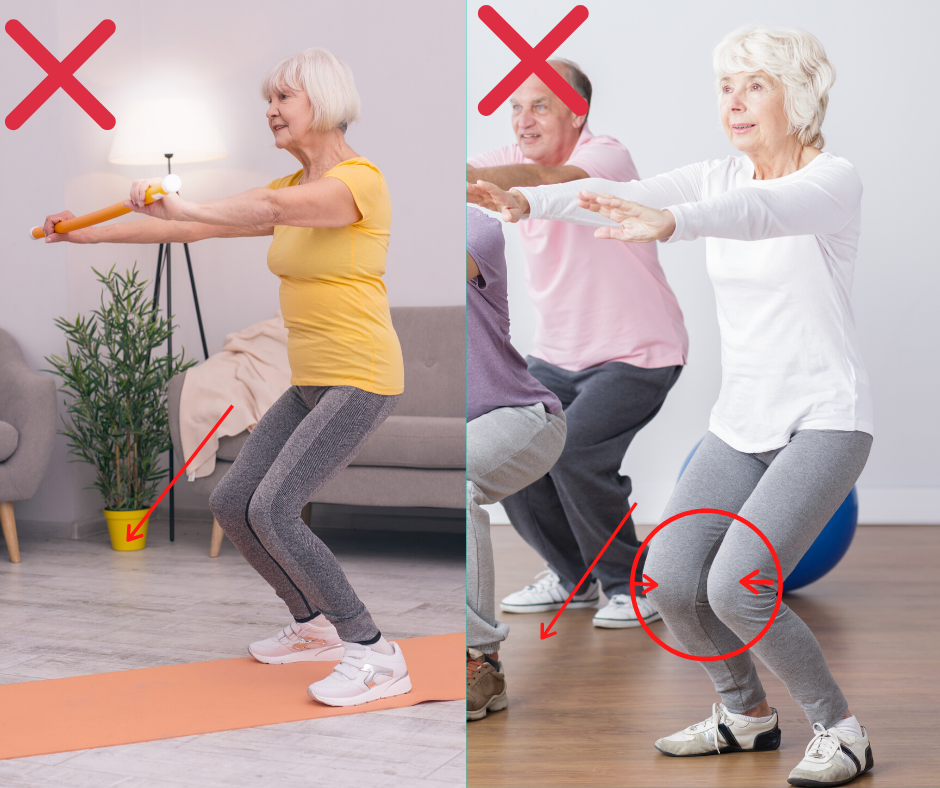
Stop the set if your knees collapse inward, your heels lift, your back rounds sharply, or you need to hold your breath. These are signs to rest or make the exercise easier.

How Often Should Seniors Do Squats?
Many health guidelines support muscle-strengthening activity on at least 2 days each week. Squats can be one part of that plan.
Avoid training the same muscles hard on consecutive days when you are new to strength exercise. Your body needs time to recover and adapt.
A simple weekly schedule might look like this:
• Monday: Chair squats and light upper-body strength work
• Tuesday: Walking and gentle balance practice
• Wednesday: Rest or easy mobility work
• Thursday: Chair squats and calf raises
• Friday: Walking
• Saturday: Optional light strength session
• Sunday: Rest
If your legs remain very sore for more than two days, reduce the number of sets or take an extra rest day. Mild muscle tiredness can be normal, but sharp pain is not.
Proper Squat Form for Seniors
Good form protects the knees, hips, back, and ankles. It also helps the correct muscles do the work.
Keep these cues in mind:
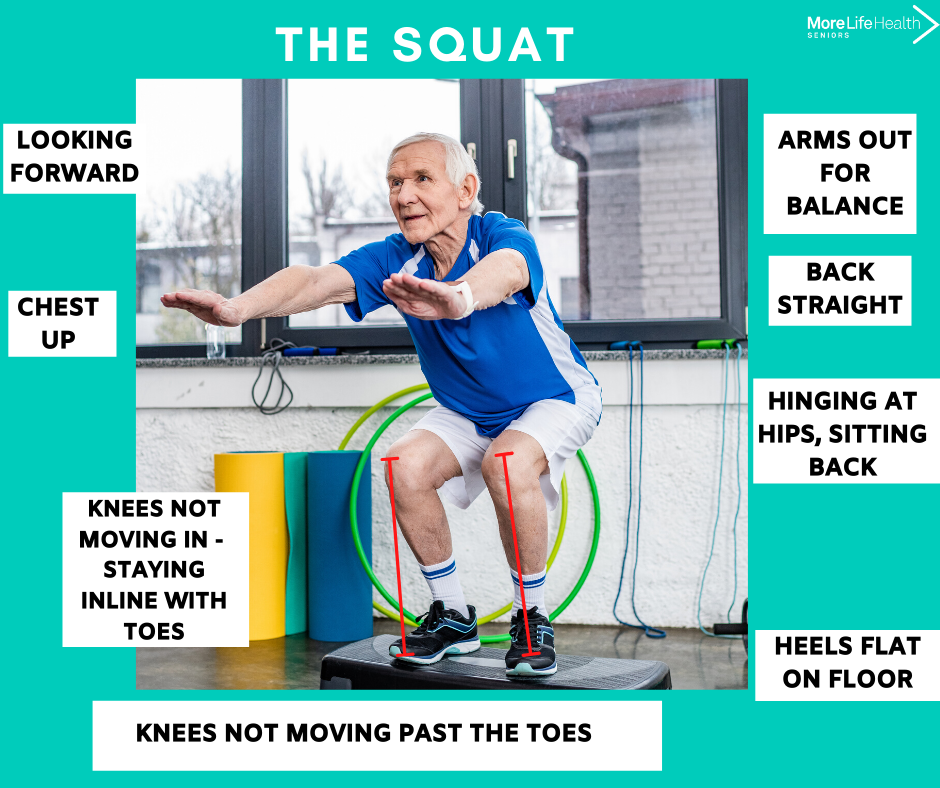
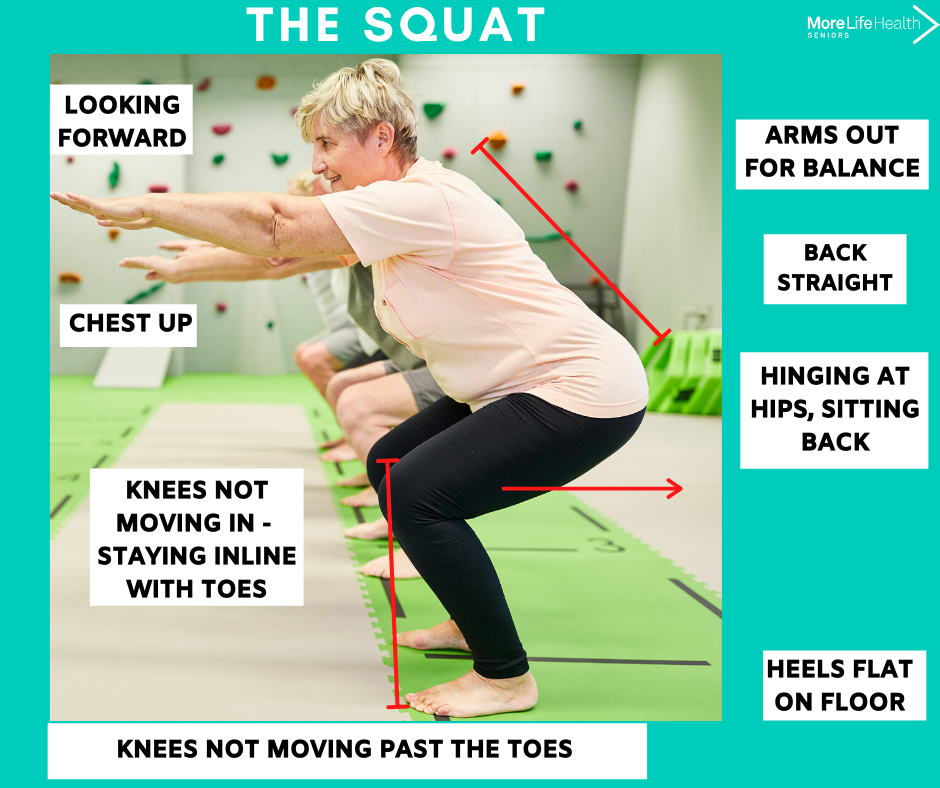
• Keep your chest lifted without leaning far backward.
• Push your hips back as you bend your knees.
• Keep your knees in line with your second and third toes.
• Keep your heels on the floor.
• Move slowly, especially while lowering.
• Keep breathing throughout the exercise.
• Use support instead of risking a loss of balance.
Your knees do not need to stay completely behind your toes. For many people, some forward knee movement is normal. The key is to avoid sudden motion, excessive depth, and pain.
A mirror can help you check your position. You can also ask a trusted family member, trainer, or physical therapist to watch your form.
When Squats May Need Modification
Squats can be adjusted for many physical limits, but some symptoms require professional advice. Speak with a health care provider before starting or changing exercise if you have:
• Recent hip, knee, or back surgery
• Severe arthritis pain
• Chest pain or unusual shortness of breath
• Frequent dizziness or fainting
• A recent fall
• Uncontrolled blood pressure
• Severe osteoporosis or a known spinal fracture
• New swelling, numbness, or weakness
Some seniors may need a supervised exercise plan. A physical therapist can adjust the chair height, movement range, foot position, and number of repetitions.
The safest answer to how many squats should a senior do may be “none today” if you have a fever, a new injury, severe pain, or unusual fatigue. Rest is part of training, not a failure.
Common Squat Mistakes to Avoid
Many problems come from doing too much too soon. These mistakes are easy to prevent.
Chasing a high number
More repetitions do not always mean better results. Stop before your form breaks down.
Dropping quickly into the squat
A fast descent can increase stress and make it harder to regain balance. Lower slowly for about two or three seconds.
Using a weak chair
A light chair may slide or tip. Choose a heavy, stable chair and keep it against a wall if needed.
Letting the knees fall inward
This can reduce control. Think about gently spreading the floor with your feet while keeping the knees aligned with the toes.
Holding your breath
Breath-holding can make some people feel lightheaded. Breathe in as you lower and breathe out as you stand.
Ignoring pain
Muscle effort is expected. Sharp, worsening, or lasting joint pain is a reason to stop and seek advice.
How to Progress Safely
Progress should be gradual. Change only one factor at a time.
You can progress by:
-
Adding 1 or 2 repetitions per set.
-
Adding a second set.
-
Lowering the chair height slightly.
-
Reducing how much you hold the support.
-
Slowing the movement.
-
Adding light resistance only after bodyweight squats feel easy.
A useful rule is to increase the weekly workload by a small amount, then watch how your body responds for several days. Do not increase repetitions, depth, speed, and weight all at once.
If you can complete 2 sets of 12 controlled squats for two or three weeks without pain, unusual fatigue, or balance problems, you may be ready for a small progression.
This gradual method answers how many squats should a senior do in a practical way. The number grows only when your body shows that it is ready.
What Results Can You Expect?
Strength improvements may appear within a few weeks, especially for beginners. You may notice that standing from a chair feels easier or that stairs require less effort.
Visible muscle changes can take longer. Results depend on age, nutrition, sleep, medical conditions, training quality, and consistency.
Squats are not a quick cure for weakness. They work best as part of a full routine that includes protein-rich foods, walking, balance practice, and enough recovery.
Keep a simple record of your repetitions and how the exercise feels. Progress may show up as better control, less support, or easier daily tasks rather than a larger number.
How Many Squats Should a Senior Do for Weight Loss?
Squats can support weight loss by building muscle and adding activity, but they do not burn enough calories alone to create major weight loss for most people.
A balanced plan may include regular walking, strength exercises for the whole body, and healthy eating. Weight loss should be gradual, especially for older adults who may be at risk of losing muscle.
Do not sharply reduce food intake without medical guidance. Adequate protein and nutrients help support muscle, bones, and recovery.
If your main goal is weight loss, ask a health professional to help you create a plan that protects strength while reducing excess body fat.
Frequently Asked Questions About How Many Squats Should a Senior Do
Is 20 squats a day good for seniors?
Twenty squats may be suitable for a strong senior with good balance and pain-free movement, but it may be too much for a beginner. Start with fewer repetitions and use a chair if needed.
Should seniors do squats every day?
Most seniors do not need to do challenging squats every day. Two or three strength sessions per week usually allow time for recovery while still supporting progress.
Are squats safe for seniors with bad knees?
Some people with knee arthritis can perform modified chair squats, but depth and volume may need to be reduced. Stop if pain increases and ask a physical therapist for an individualized plan.
What is the best squat for an older adult?
The chair squat is often a good starting choice because it provides a clear depth target and extra security. The best variation is the one you can perform with control and without pain.
Can squats help seniors avoid falls?
Squats can improve leg strength, which supports daily movement and balance recovery. They should be combined with balance exercises, safe footwear, vision care, and fall-proofing at home.
How many squats should a senior do with weights?
Begin without weights. After you can perform 2 sets of 8 to 12 bodyweight squats with excellent control, a professional may recommend very light resistance.
When should a senior stop doing squats?
Stop for sharp pain, chest pain, unusual breathlessness, dizziness, sudden weakness, or loss of balance. Seek medical help promptly for serious or new symptoms.
Conclusion
For many older adults, 1 set of 8 to 10 chair squats, two or three times per week, is a sensible starting point. Stronger seniors may progress to 2 or 3 sets of 8 to 12 repetitions, while beginners or those with health concerns may need fewer.
Focus on steady form, safe support, regular breathing, and gradual progress. Squats should help daily life feel easier, not leave you injured or exhausted. Start with a stable chair this week, track how you feel, and ask a qualified health professional for guidance if you have pain, balance concerns, or a medical condition.

Michael Reynolds is a senior contributor at RetirementGazette.com, where he focuses on helping readers navigate the journey toward a secure and fulfilling retirement. With over a decade of experience in personal finance, retirement planning, and lifestyle writing, Michael combines practical strategies with easy-to-understand guidance tailored for both pre-retirees and those already enjoying their golden years.