Most seniors are not fully exempt from property taxes, but many qualify for reductions, freezes, or payment deferrals.
The answer to “are seniors exempt from property taxes?” depends on the state, county, city, income, age, home value, and disability status. This guide explains how senior property tax exemptions work, who may qualify, how to apply, and which costly mistakes to avoid.
Are seniors exempt from property taxes?
In most parts of the United States, seniors are not automatically exempt from property taxes. Instead, states and local governments may offer special programs that lower a homeowner’s tax bill or delay payment.
These programs can take several forms:
• Property tax exemptions reduce the taxable value of a home.
• Property tax credits reduce the final tax bill.
• Property tax freezes limit how much the bill can rise.
• Property tax deferrals let eligible homeowners postpone payment.
• Circuit breaker programs limit property taxes based on household income.
The rules vary because property taxes are set mainly by local governments. A program in Florida may look very different from one in New York, Texas, or California.
So, are seniors exempt from property taxes? Usually, the answer is no. However, many older homeowners can receive meaningful tax relief if they meet the local rules and apply on time.
How senior property tax exemptions work
A property tax bill is usually based on the assessed value of your home and the local tax rate. A senior exemption may reduce the assessed value before the tax rate is applied.
For example, imagine a county assesses a home at $250,000. If the county offers a $50,000 senior exemption, the homeowner may pay taxes on $200,000 instead of $250,000. The actual savings depend on the local tax rate.
Some programs work in a different way. They may reduce the final bill by a fixed amount, such as $500, or limit the bill to a set percentage of household income.
Common program features include:
• A minimum age, often senior citizens aged 65 or older
• Ownership of the home
• Use of the home as a primary residence
• A household income limit
• A specific application deadline
• Proof of age, income, ownership, and residency
• Annual renewal or occasional recertification
A senior property tax exemption usually applies only to the home you occupy. It often does not apply to rental property, vacation homes, vacant land, or commercial buildings.
Why property tax relief differs by state
There is no single federal senior property tax exemption. Property tax programs are created by state legislatures, counties, cities, townships, or special taxing districts.
This means two neighbors may receive different benefits if their homes are in different tax districts. Even within one state, county rules can differ.
For example:
• Some states offer a standard exemption to homeowners above a certain age.
• Some states limit relief to seniors with low or moderate incomes.
• Some states provide a tax freeze but do not reduce the current bill.
• Some states allow payment deferral until the home is sold or the owner dies.
• Some states offer stronger benefits to seniors who also have disabilities or surviving spouses.
The legal details matter. A homeowner may qualify for a county exemption but still owe taxes to a city, school district, or special assessment district.
This is why checking your local tax assessor’s office is essential. General online articles can explain the process, but only the local office can confirm your eligibility and expected savings.

Common types of senior property tax relief
When people ask, “are seniors exempt from property taxes?” they may be thinking of several different programs. Understanding the difference can prevent confusion.
Senior property tax exemption
An exemption lowers the taxable value of your home. The reduction may be a fixed dollar amount or a percentage of the assessed value.
The exemption may apply only to the homeowner’s primary residence. In some areas, the benefit continues automatically after approval. In others, you must renew it each year.
Property tax freeze
A tax freeze limits future increases in property taxes. It does not always erase the current bill.
A freeze may protect a senior homeowner from sharp increases in assessed value or tax rates. However, new construction, special assessments, or changes in ownership may still affect the bill.
Property tax deferral
A deferral lets a qualified homeowner postpone property tax payments. The unpaid taxes usually become a lien against the property and may collect interest.
Payment often becomes due when the home is sold, transferred, refinanced, or no longer used as the owner’s primary residence. A deferral can help with cash flow, but it is not the same as tax forgiveness.
Property tax credit
A credit reduces the amount of tax owed. Some credits are refundable, while others can reduce the bill only to zero.
Credit programs often use household income, age, disability, and property taxes paid as part of the eligibility test.
Circuit breaker program
A circuit breaker limits property taxes when they take up too much of a household’s income. These programs are often designed for older adults, people with disabilities, and low-income homeowners or renters.
The benefit may come as a direct credit, refund, or reduction on the property tax bill.
Who may qualify for a senior property tax exemption?
Eligibility depends on the program, but many senior property tax exemptions use similar requirements.
Age requirement
Many programs require the homeowner to be 65 or older. Some begin at age 60, 62, or 70.
The important date may be your age on a specific day of the tax year. A person who turns 65 late in the year may qualify in one location but need to wait until the next year in another.
Ownership requirement
You may need to own the home by a certain date. Some programs allow a life estate, trust ownership, or ownership through a qualifying legal arrangement.
If the property is jointly owned, the rules may count the age and income of all owners. Ask the assessor how joint ownership affects your application.
Primary residence requirement
Most senior property tax exemptions apply only to a primary residence. You usually must live in the home for most of the year.
A person who owns three homes generally cannot claim the same senior benefit on all three. The property must usually be the home listed as the owner’s legal residence.
Income requirement
Some programs have no income limit. Others count all household income, including:
• Social Security
• Pension payments
• Retirement account withdrawals
• Wages
• Interest and dividends
• Rental income
• Capital gains
The definition of income varies. Do not assume that tax-free income is excluded from the property tax program.
Disability or surviving spouse status
Some local programs offer additional relief to homeowners with qualifying disabilities. A surviving spouse may also keep a tax benefit if the spouse meets age, ownership, and residency requirements.
These rules can be detailed, so request written guidance before assuming the benefit transfers automatically.
How to apply for senior property tax relief
Applying for a senior property tax exemption is usually handled through the county assessor, tax collector, or local property appraiser.
Use these steps:
-
Find your local property tax office. Search the official website for your county or city and look for senior exemption, homestead exemption, or property tax relief.
-
Review the eligibility rules. Check the age, ownership, residency, income, and deadline requirements.
-
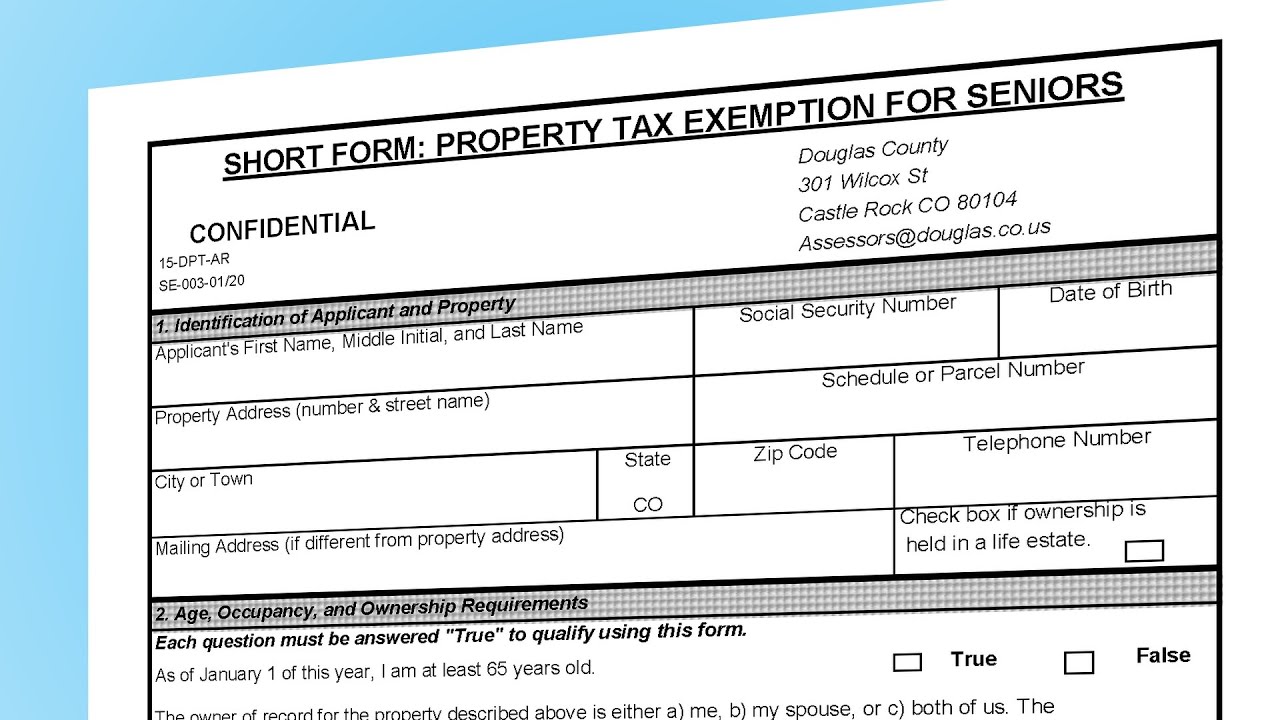
Gather your documents. Common items include a driver’s license, birth certificate, Social Security statement, pension records, tax returns, deed, and proof of residence.
-
Complete the correct form. Some states use one application for several exemptions. Others require separate forms for senior, disability, veteran, or homestead benefits.
-
Submit the application before the deadline. Late applications may be rejected or delayed until the next tax year.
-
Keep proof of submission. Save a copy of the form, supporting records, and confirmation number.
-
Review your tax bill. Make sure the approved exemption appears on the bill.
-
Appeal if needed. If the office denies your application, the notice should explain the appeal process and deadline.
Many offices offer help by phone or in person. A trusted family member may also help gather records, but never give away sensitive financial information without understanding who will receive it.
Documents seniors may need
The required documents depend on the local program. Still, preparing basic records can make the process easier.
You may need:
• Proof of age
• Proof of home ownership
• Proof that the home is your primary residence
• A current government-issued identification card
• Federal or state income tax returns
• Social Security or pension statements
• Bank or investment income records
• Disability certification, if applicable
• A death certificate for a surviving spouse claim
• Trust or life estate documents, if relevant
Income paperwork often causes the most trouble. Some programs use gross income, while others use adjusted income or a special local formula.
If you are unsure whether to include a payment, report it and ask the assessor. Leaving out income can lead to a denied application, repayment demand, penalties, or loss of future benefits.
How much can seniors save on property taxes?
Savings vary widely. A senior property tax exemption may reduce the taxable value by a few thousand dollars or by a much larger amount.
Consider a simple example. Suppose a home has a taxable value of $180,000 and the local tax rate is 1.2 percent. The annual tax would be about $2,160 before other adjustments.
If a local exemption reduces the taxable value by $40,000, the estimated tax savings would be about $480 per year. This is only an example. Local rates, school taxes, special assessments, and assessment caps can change the result.
A tax deferral may provide more immediate cash relief than a small exemption. However, the deferred amount may grow over time and reduce the equity available to the homeowner or heirs.
Before choosing a program, ask:
• How much will my annual bill decrease?
• Does the benefit cover all local taxing districts?
• Must I renew every year?
• Will the benefit affect my heirs?
• Does interest apply to deferred taxes?
• What happens if I move, rent the home, or refinance?
The best program is not always the one with the largest short-term reduction. A homeowner should also consider long-term costs and estate plans.
Mistakes to avoid when claiming senior tax relief
A common mistake is assuming that age alone creates an automatic exemption. In most areas, the homeowner must apply and prove eligibility.
Other mistakes include:
• Missing the filing deadline
• Applying for the wrong tax year
• Claiming the benefit on a second home
• Failing to report household income correctly
• Assuming a spouse automatically qualifies
• Forgetting to renew the application
• Confusing a tax freeze with tax forgiveness
• Ignoring special assessments
• Moving without notifying the assessor
• Paying a private company for a free government form
Be careful with companies that promise to eliminate your property taxes. Some legitimate firms help with appeals, but many local applications are free.
Never share bank details, Social Security numbers, or identity documents with an unknown service. Start with the official government office.
One practical lesson is to read the approval notice, not just the application form. The notice may explain renewal rules, income limits, and events that can end the benefit.
What if a senior cannot pay the property tax bill?
A senior who cannot pay should contact the tax office before the bill becomes delinquent. Waiting can lead to penalties, interest, liens, or eventually a tax sale.
Ask about:
• A senior property tax exemption
• A low-income tax credit
• A payment plan
• A property tax deferral
• A tax freeze
• A hardship program
• A deadline extension
Some programs require an application before taxes become overdue. Others may allow relief after a bill is issued.
Homeowners should also check whether they qualify for a homestead exemption, disability benefit, veteran benefit, or surviving spouse reduction. Several benefits may be available, but some cannot be combined.
If you have a mortgage escrow account, contact the mortgage servicer after the tax bill changes. The escrow payment may need adjustment, but the servicer will not always update it immediately.
Property taxes, reverse mortgages, and estate planning
A reverse mortgage does not normally remove property taxes. The homeowner remains responsible for property taxes, homeowners insurance, repairs, and other home costs.
Failure to pay property taxes can place a reverse mortgage at risk. A senior considering a reverse mortgage should ask about tax payment requirements and available local assistance.
A property tax deferral can also affect an estate. Deferred taxes may become due after death or when the property transfers. The amount owed may reduce the equity passed to heirs.
Before choosing deferral, discuss the decision with a qualified tax professional, housing counselor, or estate planning attorney. Ask for a clear estimate of the balance under different future scenarios.
For example, compare:
• Paying the taxes each year
• Using a partial exemption
• Deferring the full amount
• Selling the property later
• Leaving the home to a spouse or child
The right choice depends on income, health, housing plans, debt, and family goals.
How to check your state and county rules
Because the answer to “are seniors exempt from property taxes?” changes by location, use reliable local sources.
Start with the official website for:
• Your county assessor
• Your city tax office
• Your state department of revenue
• Your local property appraiser
You can also call the office listed on your property tax bill. Ask for the senior exemption application and the current income limits.
When speaking with an official, ask these direct questions:
-
What is the minimum age?
-
Is there an income limit?
-
Must I own the home by a certain date?
-
Does the program cover city, county, and school taxes?
-
What documents do I need?
-
Is the benefit automatic after approval?
-
Do I need to renew it?
-
Can I appeal a denial?
-
Does the program transfer to a surviving spouse?
-
What happens if I defer the taxes?
Rules can change each year. Check the current tax year’s instructions rather than relying on an old form or advice from a neighbor.
Frequently Asked Questions About Senior Property Tax Exemptions
Are seniors automatically exempt from property taxes?
No. Most seniors must meet local requirements and submit an application. Age alone usually does not cancel a property tax bill.
What age qualifies for a senior property tax exemption?
Many programs begin at age 65, but some start at 60, 62, or 70. The qualifying age and measurement date depend on the state or local government.
Can seniors with low income get property tax relief?
Often, yes. Low-income seniors may qualify for exemptions, credits, circuit breaker programs, or tax deferrals. The program may count Social Security, pensions, investments, and other household income.
Do senior citizens have to pay property taxes on a home they own?
Usually, yes, unless a local program reduces, defers, or fully removes the obligation. Even approved homeowners may still owe special assessments or taxes from other local districts.
Does a senior property tax exemption apply to rental property?
Usually not. Most senior exemptions apply only to a primary residence where the owner lives. Rental homes, vacation homes, and investment property commonly do not qualify.
Can a surviving spouse keep a senior property tax exemption?
Sometimes. A surviving spouse may need to meet age, ownership, residency, and income requirements. The benefit may not continue automatically, so contact the local assessor promptly.
Can seniors defer property taxes instead of paying them now?
Some states and counties allow qualified seniors to defer payment. The deferred amount may become a lien and collect interest, so review the repayment terms carefully.
Conclusion
Are seniors exempt from property taxes? In most cases, no automatic exemption exists, but many seniors can reduce or postpone their property tax burden through local programs.
The most important steps are simple: check your county rules, confirm the age and income limits, gather your documents, meet the deadline, and review the approval notice. Do not overlook homestead benefits, disability relief, surviving spouse rules, or tax deferral options.
Property tax laws can feel like a maze, but the local assessor’s office can help you find the right path. Explore your official state and county resources today, and share your questions or experience with senior property tax relief in the comments.

Michael Reynolds is a senior contributor at RetirementGazette.com, where he focuses on helping readers navigate the journey toward a secure and fulfilling retirement. With over a decade of experience in personal finance, retirement planning, and lifestyle writing, Michael combines practical strategies with easy-to-understand guidance tailored for both pre-retirees and those already enjoying their golden years.