
In homes across the United States, most toilet seats lift by hand from the front edge. Place one hand under the front of the seat, lift it slowly, and guide it toward the tank. If your toilet has a soft-close seat, a bidet attachment, or a raised toilet seat, use extra care because the hinges and parts may work differently.
This guide explains how to raise a standard toilet seat, lift the lid and seat together, use a raised toilet seat, and fix common problems such as a loose or stuck seat.

How to Raise a Standard Toilet Seat
A standard toilet seat has two parts:
- The lid, which covers the bowl
- The seat, which supports the user and has an open center
To raise only the seat, leave the lid down and lift the seat from its front edge. To raise both parts, lift the lid first, then lift the seat behind it.
Step-by-step instructions
-
Stand in front of the toilet.
Keep your feet clear of the bowl and floor area. -
Find the front edge of the seat.
The seat is the ring-shaped part that rests on the porcelain bowl. -
Place your fingers under the front edge.
Use a light grip. Avoid pulling on the side or on the hinge covers. -
Lift the seat slowly.
Raise it until it rests against the toilet tank or reaches its normal upright position. -
Check that it stays up.
A properly fitted seat should remain upright without falling forward. -
Lower it gently after use.
Do not let the seat or lid slam onto the bowl. Slamming can damage the hinges, bumpers, porcelain, or seat.
Most toilet seats do not have a release button or locking mechanism. If the seat feels unusually stiff, stop pulling hard. The hinge may be dirty, damaged, or misaligned.

How to Raise the Toilet Lid and Seat Together
You may want to raise both parts when cleaning the toilet, inspecting the bowl, or using the toilet with the seat out of the way.
- Lift the lid from its front edge.
- Continue moving the lid toward the tank.
- Place your other hand under the front of the seat.
- Lift the seat until it rests behind or against the lid.
- Confirm that both parts are stable before letting go.
Some toilets have a tank that slopes forward or has a small top surface. In that case, the seat may not stay upright. Do not force it against the tank. A seat that strikes the tank can chip the porcelain or damage the lid.
If the toilet seat will not remain raised, check whether:
- The seat is installed too far forward.
- The hinges are loose.
- The seat is the wrong size or shape.
- The tank is too short or angled.
- A bidet attachment is blocking the seat.
- The soft-close hinges are designed to resist fast movement.
A toilet seat that will not stay up may need adjustment or replacement rather than more force.

How to Raise a Soft-Close Toilet Seat
A soft-close toilet seat uses damped hinges to slow the lid and seat as they close. These hinges can make the seat feel heavier than a basic model.
To raise it:
- Grip the front edge of the seat or lid.
- Lift with steady, gentle pressure.
- Move it through its full range without twisting it sideways.
- Let the hinge hold the seat in its upright position.
Do not push the seat down quickly to test the soft-close feature. The hinge controls the closing speed, but it is not designed to absorb rough handling.
If the seat drops instead of staying raised, the cause may be a design limit, a loose hinge, or an installation problem. Check the installation instructions for the exact seat. Some soft-close models are not meant to hold both the lid and seat fully upright on every toilet.
How to Raise a Toilet Seat With a Bidet Attachment
A bidet attachment can change the space between the toilet tank and the seat hinges. It may also include a control panel, water connection, or raised hinge area.
Raise the seat by lifting from the front center. Avoid pulling on:
- The bidet control panel
- The water hose
- The spray nozzle
- The attachment body
- The hinge covers
Before lifting, check that the seat does not catch on the bidet attachment. If it catches, stop and inspect the installation. A seat that rubs against the attachment may be the wrong type or may need repositioning.
Never use the water hose as a handle. A damaged hose can leak and cause water damage to the bathroom floor, subfloor, or nearby cabinets.
If the bidet attachment prevents the seat from staying up, consult the attachment and toilet-seat manuals. Some installations require a compatible seat with extra clearance.

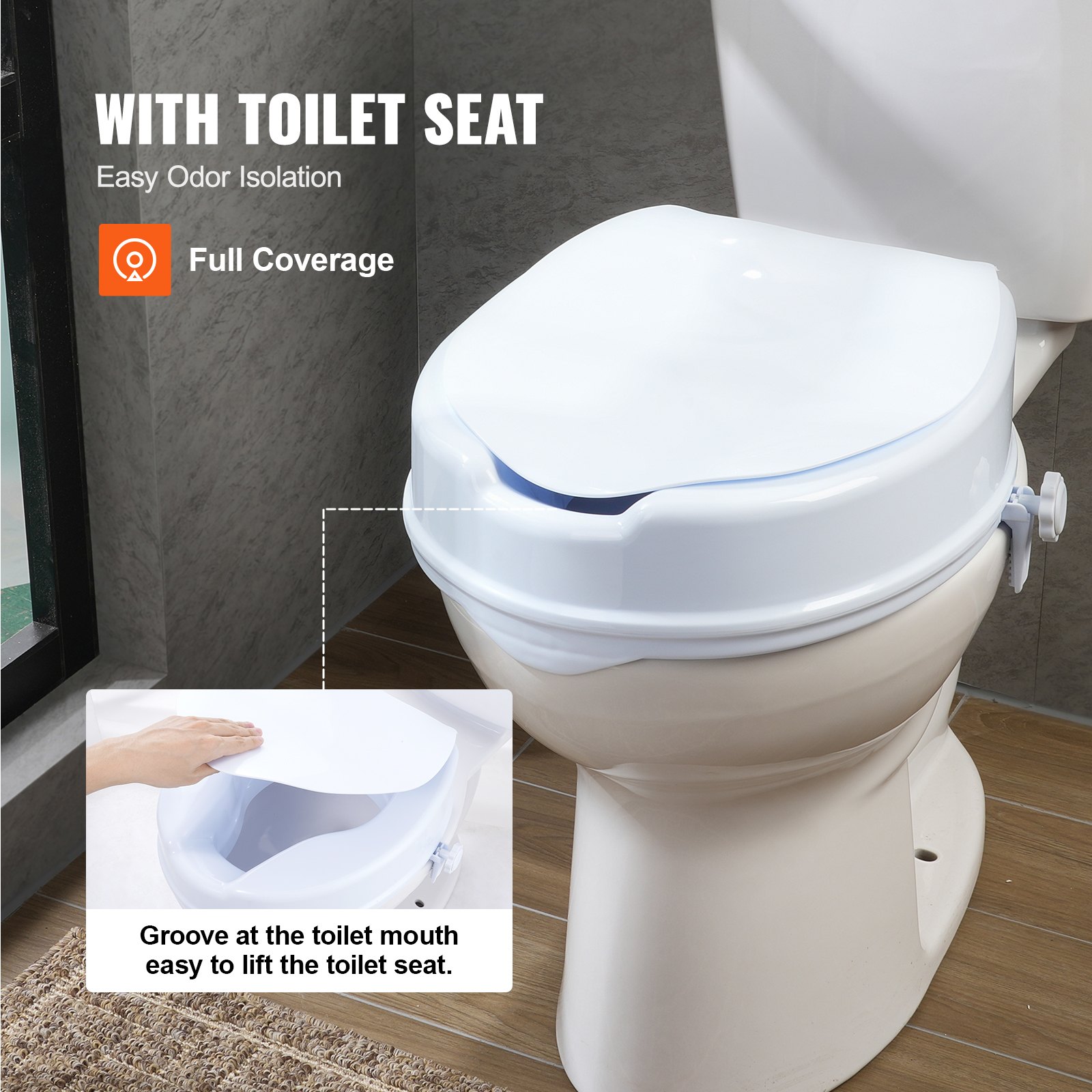
How to Raise a Raised Toilet Seat
A raised toilet seat sits above the bowl to reduce the distance a person must bend or lower their body. It may attach with clamps, brackets, or a locking mechanism.
Do not treat a raised toilet seat like a standard seat unless its instructions say that it can be lifted. Many raised seats are removable, but they are not designed to be raised during normal use.
To inspect or remove one:
- Read the product instructions first.
- Check whether the seat has side clamps or locking knobs.
- Support the seat with both hands.
- Unlock or loosen the mechanism as directed.
- Lift it straight up without rocking it.
- Set it on a clean, stable surface.
Before using the toilet again, make sure the raised seat is secure and does not shift from side to side. A loose raised seat can increase the risk of slipping or falling.
People who need a raised seat because of limited strength, balance, or joint movement may also benefit from properly installed grab bars. A towel bar is not a safe substitute for a grab bar because it may pull out of the wall.

How to Raise a Toilet Seat When It Is Stuck
A stuck seat often results from dirt, dried cleaning product, tight hinges, or a damaged mounting bolt. Use this order of checks.
1. Check for a latch or release button
Some seats have quick-release buttons near the hinges. Press them only as the manual directs. Do not pry the seat away from the bowl.
2. Clean around the hinges
Wear disposable gloves. Use a mild bathroom cleaner on a cloth, then wipe around the hinge area. Keep excess liquid away from electrical bidet parts and open bolt holes.
Never mix bleach with ammonia, vinegar, or other cleaners. Mixing cleaning products can create dangerous fumes.
3. Test the movement again
Lift from the front center with slow, even pressure. Do not twist one side higher than the other.
4. Inspect the mounting hardware
If the seat shifts, rocks, or sits crooked, the mounting hardware may be loose. Many seats use plastic or metal bolts below the bowl. Tighten them only as directed by the seat manufacturer.
Avoid overtightening. Excess force can crack the toilet bowl, especially around the mounting holes.
5. Replace damaged parts
Replace the seat if the hinge is cracked, the mounting hardware will not hold, or the seat has sharp edges. A new toilet seat is often safer than trying to repair a broken hinge.
If the toilet itself is cracked, leaking, or unstable, stop using it and contact a qualified plumber.

Toilet Seat Problems and the Best Fix
The table below matches common symptoms with likely causes and safer next steps.
| Problem | Likely cause | Recommended action |
|---|---|---|
| Seat will not lift | Dirt, tight hinge, or obstruction | Clean the hinge and check for an obstruction |
| Seat falls forward | Loose hinge, poor fit, or tank shape | Check alignment and mounting hardware |
| Seat slams shut | Standard hinge or worn soft-close damper | Lower it by hand or replace the hinge or seat |
| Seat rocks side to side | Loose mounting bolts | Tighten according to the manufacturer’s instructions |
| Seat hits the tank | Seat shape or toilet design mismatch | Check seat compatibility before replacing it |
| Seat catches on bidet attachment | Limited clearance | Use a compatible seat or adjust the attachment |
| Raised seat moves during use | Loose clamp or incorrect installation | Stop using it and reinstall it securely |
| Hinge is cracked | Damaged seat hardware | Replace the seat or approved hinge assembly |
The key distinction is between a seat that is difficult to move and a toilet that is unsafe to use. A stiff hinge may need cleaning. A cracked bowl, unstable raised seat, or leaking connection needs prompt repair.

How to Keep a Toilet Seat Easy to Raise
Simple care can prevent most lifting problems:
- Clean around the hinges during routine bathroom cleaning.
- Use a soft cloth instead of an abrasive pad.
- Do not stand on the seat or lid.
- Do not use the seat as a step.
- Keep children from swinging on the lid.
- Check mounting bolts when the seat begins to wobble.
- Follow the cleaner and care instructions for the seat material.
- Keep bidet hoses and electrical parts dry during cleaning.
- Replace cracked bumpers, hinges, and seats.
A toilet seat does not need heavy force to operate. If normal hand pressure does not move it, investigate the cause instead of pulling harder.

Frequently Asked Questions
Should I raise the toilet seat or the lid first?
Raise the lid first when you want both parts upright. If you only need to raise the seat, leave the lid closed and lift the seat from the front edge.
Why does my toilet seat keep falling down?
The seat may be loose, incorrectly positioned, incompatible with the toilet, or fitted with worn soft-close hinges. Check the hinges and mounting hardware. If the seat is correctly installed but still falls, replacement may be necessary.
Can I leave the toilet seat raised?
Yes, if the seat is stable and the bathroom setup allows it. Do not leave a raised seat in a position where it can fall, block a grab bar, or create a hazard for children or people with limited balance.
How do I raise a toilet seat without touching it?
You can use a clean tissue or disposable glove as a barrier, but do not use a foot or sharp tool. Foot pressure can damage the seat, hinge, or porcelain and may cause a slip.
How often should I replace a toilet seat?
Replace it when it cracks, becomes unstable, develops sharp edges, will not clean properly, or has damaged hinges. There is no single replacement schedule for every toilet seat.
Conclusion
To raise a standard toilet seat, lift it gently from the front edge and guide it to the upright position. Check the hinge, tank clearance, and seat stability before letting go. For soft-close seats, bidet attachments, and raised toilet seats, follow the product instructions and never force a part that catches or feels unsafe.
If cleaning and careful adjustment do not solve the problem, replace the damaged seat or ask a qualified plumber to inspect the toilet.

Michael Reynolds is a senior contributor at RetirementGazette.com, where he focuses on helping readers navigate the journey toward a secure and fulfilling retirement. With over a decade of experience in personal finance, retirement planning, and lifestyle writing, Michael combines practical strategies with easy-to-understand guidance tailored for both pre-retirees and those already enjoying their golden years.